Metabolic Cancer Therapy: Key Elements (2026 Guide)
Introduction: The Science of Metabolic Therapy in Cancer
Cancer research is undergoing a paradigm shift—from a predominantly genetic view of disease toward a more integrated understanding that includes cellular metabolism as a central driver of tumor growth. Over the past decade, advances in cancer biology have revealed that malignant cells are not only genetically altered but also metabolically reprogrammed to sustain rapid proliferation, resist cell death, and adapt to hostile microenvironments. (SpringerLink)
At its core, metabolic therapy for cancer is based on the principle that tumor cells exhibit distinct metabolic behaviors compared to normal cells. One of the most well-known examples is the Warburg effect, where cancer cells preferentially utilize aerobic glycolysis—consuming large amounts of glucose and producing lactate even in the presence of oxygen. This inefficient yet rapid energy-generating pathway supports biosynthesis, redox balance, and cellular growth, providing a selective advantage to tumors. (One Day MD)
These metabolic alterations are now recognized as a hallmark of cancer, intertwined with oncogenic signaling pathways and the tumor microenvironment. As tumors evolve, they develop metabolic plasticity, enabling them to switch between energy sources such as glucose, glutamine, and fatty acids. While this adaptability contributes to treatment resistance, it also exposes metabolic vulnerabilities that can be therapeutically targeted. (ScienceDirect)
Metabolic therapy seeks to exploit these vulnerabilities by disrupting the biochemical processes that fuel cancer cell survival. Approaches range from inhibiting glycolysis and mitochondrial respiration to modulating systemic factors such as insulin signaling, nutrient availability, and inflammation. Unlike conventional therapies that primarily target DNA replication or cell division, metabolic interventions aim to create an energetic crisis within tumor cells, impairing their ability to grow and metastasize. (One Day MD)
Importantly, metabolic therapy is not a standalone replacement for standard oncology treatments but is increasingly explored as part of a multi-modal strategy, integrating pharmacological agents, dietary interventions, and lifestyle modifications. As research progresses, the convergence of metabolic science, precision medicine, and systems biology is expected to redefine how cancer is understood and treated—shifting the focus from purely genetic mutations to the dynamic metabolic networks that sustain the disease. (One Day MD)
This evolving field—often referred to as metabolic oncology—offers a compelling framework for developing more targeted, less toxic, and potentially more effective cancer therapies, grounded in the fundamental biology of how cancer cells generate and use energy.
Ketogenic Diet and Diet for Cancer
A ketogenic diet starves the cancer cells of the nutrient energy they so heavily rely on for survival by inhibiting glycolysis and glutamine metabolism (glutaminolysis). The preclinical and emerging clinical evidence have been remarkably consistent regarding effects on cancer growth by this diet. In mice administered a ketogenic diet and in human-cancer case reports in which the ketogenic diet has been implemented, tumor growth rates have slowed. Preclinical animal studies have shown that a ketogenic diet induces significant metabolic stress in cancer cells. This stress can be exacerbated by administration of ketones which further inhibit tumor growth and metastasis. This oxidative stress is believed to render cancer cells and cancer stem cells more susceptible to both conventional and orthomolecular metabolic therapies. Emerging data supports that observation and encourages the exploration and development of new protocols for cancer treatment that utilize a ketogenic diet and ketone metabolic therapy as key component(s) of therapy.What the Evidence Shows
Fasting influences metabolic pathways and stress resistance [22]. That said, chronic extreme fasting can compromise immune surveillance.
Intermittent fasting improves metabolic health markers [23]
Ketogenic diets may alter tumor metabolism [24]
A 2026 study (American Association for Cancer Research), linked Ultra-Processed Foods to Reduced Survival after Cancer. Sugar, starch, saturated fat packed into ultra-processed food not only associated with obesity, diabetes, and heart disease, it also worsens cancer prognosis.
Another 2026 study published in The BMJ examined how everyday exposure to food preservatives influences cancer risk. Researchers analyzed long-term dietary data from the French NutriNet-Santé cohort, a large prospective study designed to follow people over time and observe how diet links to disease development. The findings were clear — people who consumed more preservatives had higher rates of overall cancer and breast cancer.
If overweight, lose weight. A 2026 findings published in Nature Communications, insulin resistance has been linked to a 25% higher risk of 12 different types of cancer. The association between insulin resistance and cancer incidence was strongest for uterine cancer, with a 134% increased risk.
A 2024 umbrella review (BMJ) of the literature confirmed what multiple studies have shown — the higher your intake of ultraprocessed food, the higher your risk of adverse health outcomes. The analysis, which included 45 unique pooled analyses and 9,888,373 participants, found direct associations between 32 health parameters and exposure to ultra processed food, including metabolic dysfunction, cancer, mental, respiratory, cardiovascular and gastrointestinal issues, as well as all-cause mortality.
Another umbrella review (BMJ 2023) of more than 8,000 studies supports the limiting dietary sugar recommendation.
The Mediterranean diet has been touted as being among the healthiest ways of eating since the 1950s when researchers first noticed that heart disease was uncommon in people from countries bordering the Mediterranean Sea. In the years since, researchers found a Mediterranean diet reduces risks of stroke, heart disease, and certain types of cancer, and even promotes longevity. (Harvard 2022)
Seyfried and others propose cancer as a metabolic disease [25], but this remains a partial model—not a complete one.
👉 Conclusion:
Dietary strategies are adjunctive, not curative.
Fasting influences metabolic pathways and stress resistance [22]. That said, chronic extreme fasting can compromise immune surveillance.
Intermittent fasting improves metabolic health markers [23]
Ketogenic diets may alter tumor metabolism [24]
A 2026 study (American Association for Cancer Research), linked Ultra-Processed Foods to Reduced Survival after Cancer. Sugar, starch, saturated fat packed into ultra-processed food not only associated with obesity, diabetes, and heart disease, it also worsens cancer prognosis.
Another 2026 study published in The BMJ examined how everyday exposure to food preservatives influences cancer risk. Researchers analyzed long-term dietary data from the French NutriNet-Santé cohort, a large prospective study designed to follow people over time and observe how diet links to disease development. The findings were clear — people who consumed more preservatives had higher rates of overall cancer and breast cancer.
If overweight, lose weight. A 2026 findings published in Nature Communications, insulin resistance has been linked to a 25% higher risk of 12 different types of cancer. The association between insulin resistance and cancer incidence was strongest for uterine cancer, with a 134% increased risk.
A 2024 umbrella review (BMJ) of the literature confirmed what multiple studies have shown — the higher your intake of ultraprocessed food, the higher your risk of adverse health outcomes. The analysis, which included 45 unique pooled analyses and 9,888,373 participants, found direct associations between 32 health parameters and exposure to ultra processed food, including metabolic dysfunction, cancer, mental, respiratory, cardiovascular and gastrointestinal issues, as well as all-cause mortality.
Another umbrella review (BMJ 2023) of more than 8,000 studies supports the limiting dietary sugar recommendation.
The Mediterranean diet has been touted as being among the healthiest ways of eating since the 1950s when researchers first noticed that heart disease was uncommon in people from countries bordering the Mediterranean Sea. In the years since, researchers found a Mediterranean diet reduces risks of stroke, heart disease, and certain types of cancer, and even promotes longevity. (Harvard 2022)
Seyfried and others propose cancer as a metabolic disease [25], but this remains a partial model—not a complete one.
👉 Conclusion:
Dietary strategies are adjunctive, not curative.
Repurposed Drugs
This is the core of many viral videos.
Scientific Reality
Drug repurposing is a legitimate field:
-
It aims to identify new uses for existing drugs [26,27, 30]
Limitations
Drug repurposing is a legitimate field:
-
It aims to identify new uses for existing drugs [26,27, 30]
-
Poor bioavailability
-
High doses required
-
Limited human trials
👉 Key point:
Promising ≠ proven.
-
Poor bioavailability
-
High doses required
-
Limited human trials
👉 Key point:
Promising ≠ proven.
Vitamins/Supplements
Natural compounds like:
-
Curcumin
-
Polyphenols
…have demonstrated:
-
Anti-inflammatory effects
-
Anti-proliferative activity [28,29]
Cancer Metabolism: Beyond the Warburg Effect
One of the most common claims is:
“Cancer is a metabolic disease.”
This idea originates from the Warburg effect, where cancer cells rely on glycolysis even in the presence of
oxygen [1,2].
Modern research confirms that metabolic reprogramming is indeed
a core hallmark of cancer [3,4].
However, the reality is more complex:
-
Cancer metabolism includes:
-
Glucose
-
Glutamine
-
Lipids
-
It supports:
-
Rapid proliferation
-
Biomass synthesis
-
Redox balance [3,5]
👉 Key insight:
Metabolism is essential—but cancer is not purely metabolic. It is also genetic, immunological, and
microenvironment-driven [32,33].
One of the most common claims is:
“Cancer is a metabolic disease.”
This idea originates from the Warburg effect, where cancer cells rely on glycolysis even in the presence of oxygen [1,2].
Modern research confirms that metabolic reprogramming is indeed a core hallmark of cancer [3,4].
However, the reality is more complex:
-
Cancer metabolism includes:
-
Glucose
-
Glutamine
-
Lipids
-
-
It supports:
-
Rapid proliferation
-
Biomass synthesis
-
Redox balance [3,5]
-
👉 Key insight:
Metabolism is essential—but cancer is not purely metabolic. It is also genetic, immunological, and
microenvironment-driven [32,33].
Metabolic Plasticity: Why “Starving Cancer” Isn’t Simple
A major oversimplification in viral content is:
“Cut sugar → cancer dies”
In reality, cancer cells are highly adaptable.
They can switch between:
-
Glycolysis
-
Oxidative phosphorylation
-
Fatty acid metabolism [6–9]
This phenomenon—metabolic plasticity—allows tumors to survive even under stress.
👉 Implication:
Single interventions (e.g., ketogenic diet alone) are unlikely
to be curative.
A major oversimplification in viral content is:
“Cut sugar → cancer dies”
In reality, cancer cells are highly adaptable.
They can switch between:
-
Glycolysis
-
Oxidative phosphorylation
-
Fatty acid metabolism [6–9]
This phenomenon—metabolic plasticity—allows tumors to survive even under stress.
👉 Implication:
Single interventions (e.g., ketogenic diet alone) are unlikely
to be curative.
Immunometabolism: Where Metabolism Meets Immunity
A major breakthrough in oncology is the field of immunometabolism.
Research shows:
-
Tumor metabolism suppresses immune function [10,11]
-
Lactate accumulation inhibits T-cell activity [14]
-
Nutrient competition weakens immune responses [39,40]
👉 Cancer doesn’t just grow—it actively disarms the immune system.
This explains why:
-
Some patients fail immunotherapy
-
Others respond dramatically
A major breakthrough in oncology is the field of immunometabolism.
Research shows:
-
Tumor metabolism suppresses immune function [10,11]
-
Lactate accumulation inhibits T-cell activity [14]
-
Nutrient competition weakens immune responses [39,40]
👉 Cancer doesn’t just grow—it actively disarms the immune system.
This explains why:
-
Some patients fail immunotherapy
-
Others respond dramatically
Tumor Microenvironment: The Hidden Battlefield
Cancer exists within a complex ecosystem known as
the tumor microenvironment (TME).
This includes:
-
Immune cells
-
Blood vessels
-
Fibroblasts
-
Metabolites
Studies show this environment:
-
Promotes tumor growth
-
Suppresses immunity
-
Drives metastasis [15,16]
👉 Viral videos almost never address this—but it’s central to
modern oncology.
Cancer exists within a complex ecosystem known as the tumor microenvironment (TME).
This includes:
-
Immune cells
-
Blood vessels
-
Fibroblasts
-
Metabolites
Studies show this environment:
-
Promotes tumor growth
-
Suppresses immunity
-
Drives metastasis [15,16]
👉 Viral videos almost never address this—but it’s central to modern oncology.
The Microbiome Revolution
One of the strongest scientific developments is the role of
the gut microbiome.
One of the strongest scientific developments is the role of the gut microbiome.
Landmark Findings
-
Gut bacteria influence immunotherapy response [17–20]
-
Microbiome composition affects survival outcomes [21]
👉 This explains why:
-
Two patients with identical cancers respond differently
-
Gut bacteria influence immunotherapy response [17–20]
-
Microbiome composition affects survival outcomes [21]
👉 This explains why:
-
Two patients with identical cancers respond differently
Immunotherapy: The Real Breakthrough
Checkpoint inhibitors have transformed cancer treatment.
Checkpoint inhibitors have transformed cancer treatment.
Evidence
-
They activate T-cells against tumors [34,35]
-
Durable responses occur in some patients
But:
-
Many patients do not respond
-
Resistance mechanisms exist
👉 Tumor metabolism and microenvironment play a major role in this
resistance.
-
They activate T-cells against tumors [34,35]
-
Durable responses occur in some patients
But:
-
Many patients do not respond
-
Resistance mechanisms exist
👉 Tumor metabolism and microenvironment play a major role in this resistance.
Inflammation, Insulin, and Cancer Progression
Chronic inflammation is a key driver of cancer.
-
Inflammatory pathways promote tumor growth [37,38]
Metabolic dysfunction also matters:
-
Insulin resistance is linked to cancer risk [41,42]
👉 This supports lifestyle interventions—but not as standalone
cures.
Chronic inflammation is a key driver of cancer.
-
Inflammatory pathways promote tumor growth [37,38]
Metabolic dysfunction also matters:
-
Insulin resistance is linked to cancer risk [41,42]
👉 This supports lifestyle interventions—but not as standalone cures.
The Reality: Cancer Is a Systems Disease
Bringing everything together:
Cancer involves:
-
Metabolic reprogramming
-
Immune evasion
-
Genetic mutations
-
Microenvironment interactions
No single therapy addresses all of these.
Bringing everything together:
Cancer involves:
-
Metabolic reprogramming
-
Immune evasion
-
Genetic mutations
-
Microenvironment interactions
No single therapy addresses all of these.
Additional Interventions
Hyperbaric Oxygen Therapy (HBOT) has potent anti-cancer activity because a tissue environment of low oxygen (hypoxia) enhances malignant cells survival, angiogenesis, metastasis, glycolysis and glutaminolysis. The high oxygen environment induced by HBOT counteracts the tumor promoting effects of hypoxia and can target cancer stem cells and inhibit cancer growth and metastasis. HBOT is synergistic with a ketogenic diet in the suppression of cancer growth and metastasis with both of these interventions used with inhibitors of glycolysis and glutaminolysis in the Press-Pulse Therapy.
Physical Activity is believed to have beneficial effects in cancer prevention by inhibiting weight gain and development of diabetes, both of which promote cancer stem cells and tumor development. Additionally, exercise decreases glycolysis and favors mitochondrial respiration via oxidative phosphorylation when conducted at low to moderate intensity. Physical activity also inhibits cancer cell proliferation and induces cancer cell death via apoptosis.
Sauna therapy, particularly infrared saunas, improves mitochondrial function through several key pathways. Exposure to high temperatures triggers the production of heat shock proteins, which protect and repair cellular structures, including mitochondria, by maintaining protein quality control. Additionally, sauna therapy stimulates mitochondrial biogenesis by activating PGC-1α, leading to an increase in the number of mitochondria. This therapy also enhances mitochondrial efficiency by optimizing the electron transport chain and oxidative phosphorylation processes, resulting in more ATP production per unit of substrate. Sauna use improves blood circulation and oxygen delivery, ensuring mitochondria have an adequate oxygen supply for efficient energy production. The detoxification benefits of sauna therapy, which eliminate toxins and heavy metals, reduce oxidative stress on mitochondria, allowing them to function more efficiently. Together, these effects contribute to improved cellular energy production and overall metabolic health, making sauna therapy a valuable tool for optimizing mitochondrial function.
Evidence-Based 2026 Framework
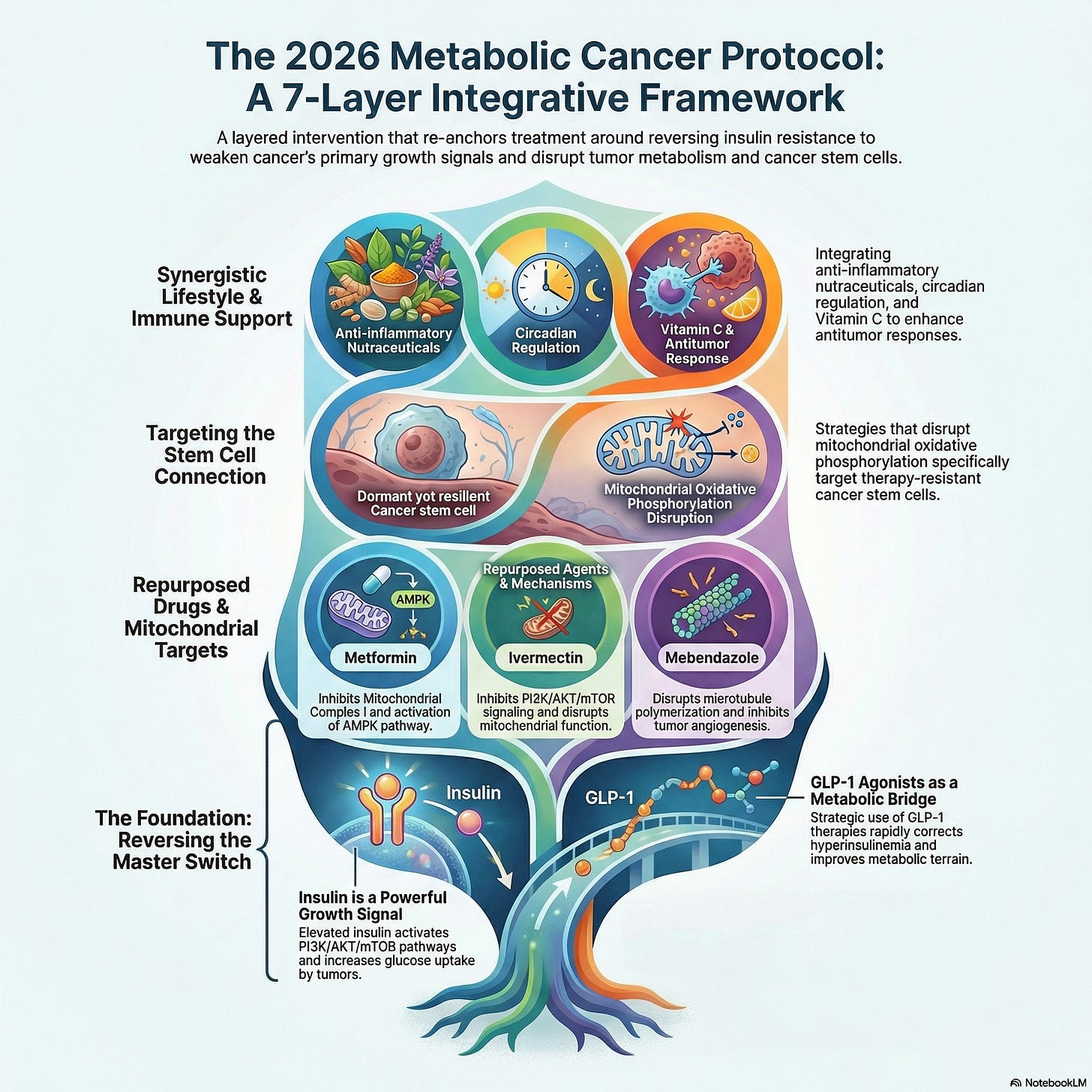
A Rational 7-Layer Model
-
Metabolic modulation
-
Target glycolysis and mitochondria [1–5]
-
Tumor-directed therapy
-
Surgery (when feasible)
-
Chemotherapy
-
Radiation therapy
-
Immunotherapy
-
Immune optimization
-
Restore T-cell function [10–14]
-
Microbiome support
-
Enhance treatment response [17–21]
-
Adjunct therapies
-
Repurposed drugs, natural compounds [26–29]
-
Dietary strategies
-
Improve metabolic environment [22–24]
-
Lifestyle optimization
-
Reduce inflammation and insulin resistance [37–42]
-
Metabolic modulation
-
Target glycolysis and mitochondria [1–5]
-
-
Tumor-directed therapy
-
Surgery (when feasible)
-
Chemotherapy
-
Radiation therapy
-
Immunotherapy
-
-
Immune optimization
-
Restore T-cell function [10–14]
-
-
Microbiome support
-
Enhance treatment response [17–21]
-
-
Adjunct therapies
-
Repurposed drugs, natural compounds [26–29]
-
-
Dietary strategies
-
Improve metabolic environment [22–24]
-
-
Lifestyle optimization
-
Reduce inflammation and insulin resistance [37–42]
-
Final Verdict: What the Science Supports
Supported
✔ Cancer metabolism is real
✔ Immunometabolism is critical
✔ Microbiome influences outcomes
✔ Combination strategies are necessary
✔ Cancer metabolism is real
✔ Immunometabolism is critical
✔ Microbiome influences outcomes
✔ Combination strategies are necessary
Not Supported
❌ Universal cure claims
❌ Diet-alone cures
❌ One-drug-for-all-cancers narratives
❌ Universal cure claims
❌ Diet-alone cures
❌ One-drug-for-all-cancers narratives
Viral cancer content succeeds because it offers:
-
Simplicity
-
Hope
-
Control
But science demands:
-
Complexity
-
Evidence
-
Precision
👉 The future of oncology is not about choosing between
conventional and alternative.
It is about integrating both—based on evidence.
Viral cancer content succeeds because it offers:
-
Simplicity
-
Hope
-
Control
But science demands:
-
Complexity
-
Evidence
-
Precision
👉 The future of oncology is not about choosing between conventional and alternative.
It is about integrating both—based on evidence.
Key Takeaways
The biggest mistake in cancer treatment thinking is choosing
between:
-
Conventional medicine
-
Alternative approaches
👉 The real solution is:
Integration, prioritization, and evidence-based
layering.
The biggest mistake in cancer treatment thinking is choosing between:
-
Conventional medicine
-
Alternative approaches
👉 The real solution is:
Integration, prioritization, and evidence-based layering.
📚 References
🔬 Cancer Metabolism & Warburg Effect
-
Vander Heiden MG, Cantley LC, Thompson CB. Understanding
the Warburg effect: the metabolic requirements of cell
proliferation. Science. 2009;324(5930):1029–1033.
-
Liberti MV, Locasale JW. The Warburg effect: how does it
benefit cancer cells? Trends Biochem Sci. 2016;41(3):211–218.
-
Pavlova NN, Thompson CB. The emerging hallmarks of cancer
metabolism. Cell Metab. 2016;23(1):27–47.
-
Ward PS, Thompson CB. Metabolic reprogramming: a cancer
hallmark even Warburg did not anticipate. Cancer Cell. 2012;21(3):297–308.
-
DeBerardinis RJ, Chandel NS. Fundamentals of cancer
metabolism. Sci Adv. 2016;2(5):e1600200.
-
Vander Heiden MG, Cantley LC, Thompson CB. Understanding the Warburg effect: the metabolic requirements of cell proliferation. Science. 2009;324(5930):1029–1033.
-
Liberti MV, Locasale JW. The Warburg effect: how does it benefit cancer cells? Trends Biochem Sci. 2016;41(3):211–218.
-
Pavlova NN, Thompson CB. The emerging hallmarks of cancer metabolism. Cell Metab. 2016;23(1):27–47.
-
Ward PS, Thompson CB. Metabolic reprogramming: a cancer hallmark even Warburg did not anticipate. Cancer Cell. 2012;21(3):297–308.
-
DeBerardinis RJ, Chandel NS. Fundamentals of cancer metabolism. Sci Adv. 2016;2(5):e1600200.
⚙️ Metabolic Plasticity & Adaptation
-
Faubert B, Solmonson A, DeBerardinis RJ. Metabolic
reprogramming and cancer progression. Science. 2020;368(6487):eaaw5473.
-
Martinez-Outschoorn UE, et al. Cancer metabolism: a
therapeutic perspective. Nat Rev Clin Oncol. 2017;14(1):11–31.
-
Vasan K, Werner M, Chandel NS. Mitochondrial metabolism as
a target for cancer therapy. Cell Metab. 2020;32(3):341–352.
-
Ashton TM, et al. Oxidative phosphorylation as an emerging
target in cancer therapy. Clin Cancer Res. 2018;24(11):2482–2490.
-
Faubert B, Solmonson A, DeBerardinis RJ. Metabolic reprogramming and cancer progression. Science. 2020;368(6487):eaaw5473.
-
Martinez-Outschoorn UE, et al. Cancer metabolism: a therapeutic perspective. Nat Rev Clin Oncol. 2017;14(1):11–31.
-
Vasan K, Werner M, Chandel NS. Mitochondrial metabolism as a target for cancer therapy. Cell Metab. 2020;32(3):341–352.
-
Ashton TM, et al. Oxidative phosphorylation as an emerging target in cancer therapy. Clin Cancer Res. 2018;24(11):2482–2490.
🧠 Immunometabolism & Tumor Microenvironment
-
Buck MD, Sowell RT, Kaech SM, Pearce EL. Metabolic
instruction of immunity. Cell. 2017;169(4):570–586.
-
O’Neill LAJ, Kishton RJ, Rathmell J. A guide to
immunometabolism. Nat Rev Immunol. 2016;16(9):553–565.
-
Leone RD, Powell JD. Metabolism of immune cells in
cancer. Nat Rev Cancer. 2020;20(9):516–531.
-
Biswas SK. Metabolic reprogramming of immune cells in
cancer progression. Immunity. 2015;43(3):435–449.
-
Colegio OR, et al. Functional polarization of
tumour-associated macrophages by tumour-derived lactic
acid. Nature. 2014;513(7519):559–563.
-
Buck MD, Sowell RT, Kaech SM, Pearce EL. Metabolic instruction of immunity. Cell. 2017;169(4):570–586.
-
O’Neill LAJ, Kishton RJ, Rathmell J. A guide to immunometabolism. Nat Rev Immunol. 2016;16(9):553–565.
-
Leone RD, Powell JD. Metabolism of immune cells in cancer. Nat Rev Cancer. 2020;20(9):516–531.
-
Biswas SK. Metabolic reprogramming of immune cells in cancer progression. Immunity. 2015;43(3):435–449.
-
Colegio OR, et al. Functional polarization of tumour-associated macrophages by tumour-derived lactic acid. Nature. 2014;513(7519):559–563.
🧬 Tumor Microenvironment & Immune Suppression
-
Hinshaw DC, Shevde LA. The tumor microenvironment innately
modulates cancer progression. Cancer Res. 2019;79(18):4557–4566.
-
Quail DF, Joyce JA. Microenvironmental regulation of tumor
progression and metastasis. Nat Med. 2013;19(11):1423–1437.
-
Hinshaw DC, Shevde LA. The tumor microenvironment innately modulates cancer progression. Cancer Res. 2019;79(18):4557–4566.
-
Quail DF, Joyce JA. Microenvironmental regulation of tumor progression and metastasis. Nat Med. 2013;19(11):1423–1437.
🦠 Microbiome & Cancer
-
Routy B, et al. Gut microbiome influences efficacy of
PD-1-based immunotherapy. Science. 2018;359(6371):91–97.
-
Gopalakrishnan V, et al. Gut microbiome modulates response
to anti–PD-1 immunotherapy. Science. 2018;359(6371):97–103.
-
Zitvogel L, Ma Y, Raoult D, Kroemer G, Gajewski TF. The
microbiome in cancer immunotherapy. Nat Rev Immunol. 2018;18(8):521–533.
-
Matson V, et al. The commensal microbiome is associated
with anti–PD-1 efficacy. Science. 2018;359(6371):104–108.
-
Helmink BA, et al. The microbiome, cancer, and cancer
therapy. Nat Med. 2019;25(3):377–388.
-
Routy B, et al. Gut microbiome influences efficacy of PD-1-based immunotherapy. Science. 2018;359(6371):91–97.
-
Gopalakrishnan V, et al. Gut microbiome modulates response to anti–PD-1 immunotherapy. Science. 2018;359(6371):97–103.
-
Zitvogel L, Ma Y, Raoult D, Kroemer G, Gajewski TF. The microbiome in cancer immunotherapy. Nat Rev Immunol. 2018;18(8):521–533.
-
Matson V, et al. The commensal microbiome is associated with anti–PD-1 efficacy. Science. 2018;359(6371):104–108.
-
Helmink BA, et al. The microbiome, cancer, and cancer therapy. Nat Med. 2019;25(3):377–388.
🥗 Diet, Fasting & Metabolic Therapy
-
Longo VD, Mattson MP. Fasting: molecular mechanisms and
clinical applications. Cell Metab. 2014;19(2):181–192.
-
de Cabo R, Mattson MP. Effects of intermittent fasting on
health and disease. N Engl J Med. 2019;381(26):2541–2551.
-
Klement RJ. The emerging role of ketogenic diets in cancer
treatment. Curr Opin Clin Nutr Metab Care. 2019;22(2):129–134.
-
Seyfried TN, Flores RE, Poff AM, D’Agostino DP. Cancer as a
metabolic disease. Carcinogenesis. 2014;35(3):515–527.
-
Longo VD, Mattson MP. Fasting: molecular mechanisms and clinical applications. Cell Metab. 2014;19(2):181–192.
-
de Cabo R, Mattson MP. Effects of intermittent fasting on health and disease. N Engl J Med. 2019;381(26):2541–2551.
-
Klement RJ. The emerging role of ketogenic diets in cancer treatment. Curr Opin Clin Nutr Metab Care. 2019;22(2):129–134.
-
Seyfried TN, Flores RE, Poff AM, D’Agostino DP. Cancer as a metabolic disease. Carcinogenesis. 2014;35(3):515–527.
💊 Repurposed Drugs & Adjunct Compounds
-
Pantziarka P, et al. Repurposing drugs in oncology
(ReDO). ecancermedicalscience. 2014;8:442.
-
Pushpakom S, et al. Drug repurposing: progress, challenges
and recommendations. Nat Rev Drug Discov. 2019;18(1):41–58.
-
Ashrafizadeh M, et al. Curcumin in cancer
therapy. J Cell Physiol. 2020;235(12):9247–9266.
-
Gupta SC, et al. Multitargeting by curcumin as revealed by
molecular interaction studies. Nat Prod Rep. 2011;28(12):1937–1955.
-
OneDayMD, et al. Top 20 Alternative Cancer Treatments that Work: Evidence Based. OneDayMD. 2026.
-
Pantziarka P, et al. Repurposing drugs in oncology (ReDO). ecancermedicalscience. 2014;8:442.
-
Pushpakom S, et al. Drug repurposing: progress, challenges and recommendations. Nat Rev Drug Discov. 2019;18(1):41–58.
-
Ashrafizadeh M, et al. Curcumin in cancer therapy. J Cell Physiol. 2020;235(12):9247–9266.
-
Gupta SC, et al. Multitargeting by curcumin as revealed by molecular interaction studies. Nat Prod Rep. 2011;28(12):1937–1955.
-
OneDayMD, et al. Top 20 Alternative Cancer Treatments that Work: Evidence Based. OneDayMD. 2026.
🧬 Hallmarks of Cancer
-
Hanahan D, Weinberg RA. Hallmarks of cancer: the next
generation. Cell. 2011;144(5):646–674.
-
Hanahan D. Hallmarks of cancer: new dimensions. Cancer Discov. 2022;12(1):31–46.
-
Hanahan D, Weinberg RA. Hallmarks of cancer: the next generation. Cell. 2011;144(5):646–674.
-
Hanahan D. Hallmarks of cancer: new dimensions. Cancer Discov. 2022;12(1):31–46.
🧪 Clinical Oncology & Immunotherapy
-
Sharma P, Allison JP. Immune checkpoint targeting in cancer
therapy. Science. 2015;348(6230):56–61.
-
Ribas A, Wolchok JD. Cancer immunotherapy using checkpoint
blockade. Science. 2018;359(6382):1350–1355.
-
Topalian SL, et al. Safety and activity of anti–PD-1
antibody. N Engl J Med. 2012;366(26):2443–2454.
-
Sharma P, Allison JP. Immune checkpoint targeting in cancer therapy. Science. 2015;348(6230):56–61.
-
Ribas A, Wolchok JD. Cancer immunotherapy using checkpoint blockade. Science. 2018;359(6382):1350–1355.
-
Topalian SL, et al. Safety and activity of anti–PD-1 antibody. N Engl J Med. 2012;366(26):2443–2454.
🔥 Inflammation & Cancer
-
Greten FR, Grivennikov SI. Inflammation and
cancer. Nature. 2019;574(7775):27–37.
-
Coussens LM, Werb Z. Inflammation and cancer. Nature. 2002;420(6917):860–867.
-
Greten FR, Grivennikov SI. Inflammation and cancer. Nature. 2019;574(7775):27–37.
-
Coussens LM, Werb Z. Inflammation and cancer. Nature. 2002;420(6917):860–867.
⚡ Metabolism-Immune Crosstalk
-
Chang CH, et al. Metabolic competition in the tumor
microenvironment. Cell. 2015;162(6):1229–1241.
-
Ho PC, et al. Phosphoenolpyruvate is a metabolic checkpoint
of T cell function. Cell. 2015;162(6):1217–1228.
-
Chang CH, et al. Metabolic competition in the tumor microenvironment. Cell. 2015;162(6):1229–1241.
-
Ho PC, et al. Phosphoenolpyruvate is a metabolic checkpoint of T cell function. Cell. 2015;162(6):1217–1228.
🧠 Insulin Resistance & Cancer
-
Gallagher EJ, LeRoith D. Insulin resistance in
cancer. Endocr Relat Cancer. 2015;22(5):R211–R224.
-
Giovannucci E, et al. Diabetes and cancer. Diabetes Care. 2010;33(7):1674–1685.
-
Gallagher EJ, LeRoith D. Insulin resistance in cancer. Endocr Relat Cancer. 2015;22(5):R211–R224.
-
Giovannucci E, et al. Diabetes and cancer. Diabetes Care. 2010;33(7):1674–1685.
🧬 Additional Supporting References
-
DeBerardinis RJ. Tumor metabolism and its therapeutic
implications. Annu Rev Med. 2012;63:19–32.
-
Hensley CT, et al. Glutamine metabolism in
cancer. Nat Rev Cancer. 2013;13(12):759–773.
-
Pavlova NN. Emerging roles of metabolism in cancer
therapy. Nat Rev Cancer. 2022.
-
Sullivan LB, et al. Supporting roles of mitochondria in
cancer. Cancer Cell. 2016.
-
Lyssiotis CA, Kimmelman AC. Metabolic interactions in tumor
microenvironment. Cell. 2017.
-
Vander Heiden MG. Targeting cancer metabolism. Nat Rev Drug Discov. 2011.
-
Schulze A, Harris AL. How cancer metabolism is
tuned. Nature. 2012.
-
Galluzzi L, et al. Metabolic control of immune
response. Nat Rev Immunol. 2020.
-
DeBerardinis RJ. Tumor metabolism and its therapeutic implications. Annu Rev Med. 2012;63:19–32.
-
Hensley CT, et al. Glutamine metabolism in cancer. Nat Rev Cancer. 2013;13(12):759–773.
-
Pavlova NN. Emerging roles of metabolism in cancer therapy. Nat Rev Cancer. 2022.
-
Sullivan LB, et al. Supporting roles of mitochondria in cancer. Cancer Cell. 2016.
-
Lyssiotis CA, Kimmelman AC. Metabolic interactions in tumor microenvironment. Cell. 2017.
-
Vander Heiden MG. Targeting cancer metabolism. Nat Rev Drug Discov. 2011.
-
Schulze A, Harris AL. How cancer metabolism is tuned. Nature. 2012.
-
Galluzzi L, et al. Metabolic control of immune response. Nat Rev Immunol. 2020.


.png)
.png)


.png)

.png)
Comments
Post a Comment