Top Oncology Companies in 2026: The Global Leaders in Oncology and Immunotherapy
Medically & Financially Reviewed by: Dr. Frank Yap, MD, MBA | Written by: OneDayAdvisor Editorial Team | Last Updated: September 2026 (includes Johnson & Johnson's July 15, 2026 Q2 earnings release)
Quick Answer
Merck & Co. remains the world's largest cancer drug company in 2026, on the strength of Keytruda's $8.03 billion in Q1 2026 sales alone. But the gap is closing fast: Johnson & Johnson just posted $7.4 billion in quarterly oncology revenue (Q2 2026, +16.1% YoY) and says it's on track to become the world's #1 oncology company by 2030. AstraZeneca and a resurgent Pfizer oncology franchise (built on the Seagen acquisition) round out the fastest-growing tier, while Bristol Myers Squibb is managing a steep decline in legacy Revlimid and Opdivo alongside triple-digit growth in newer cell therapies. The competitive picture keeps shifting: Merck's Keytruda faces a 2028 patent cliff, BMS's Revlimid has already lost roughly half its sales to generics, and a wave of Chinese-originated antibody-drug conjugates and PD-1×VEGF bispecifics is reshaping pipelines industry-wide.
The global oncology market entered 2026 in the middle of a genuine changing of the guard. Legacy blockbusters are still generating the biggest single numbers — Keytruda chief among them — but Q1 and Q2 2026 earnings show the real story is which companies are converting CAR-T therapies, antibody-drug conjugates (ADCs), and radioligand platforms into double-digit oncology growth before the patent cliffs of 2028–2030 arrive.
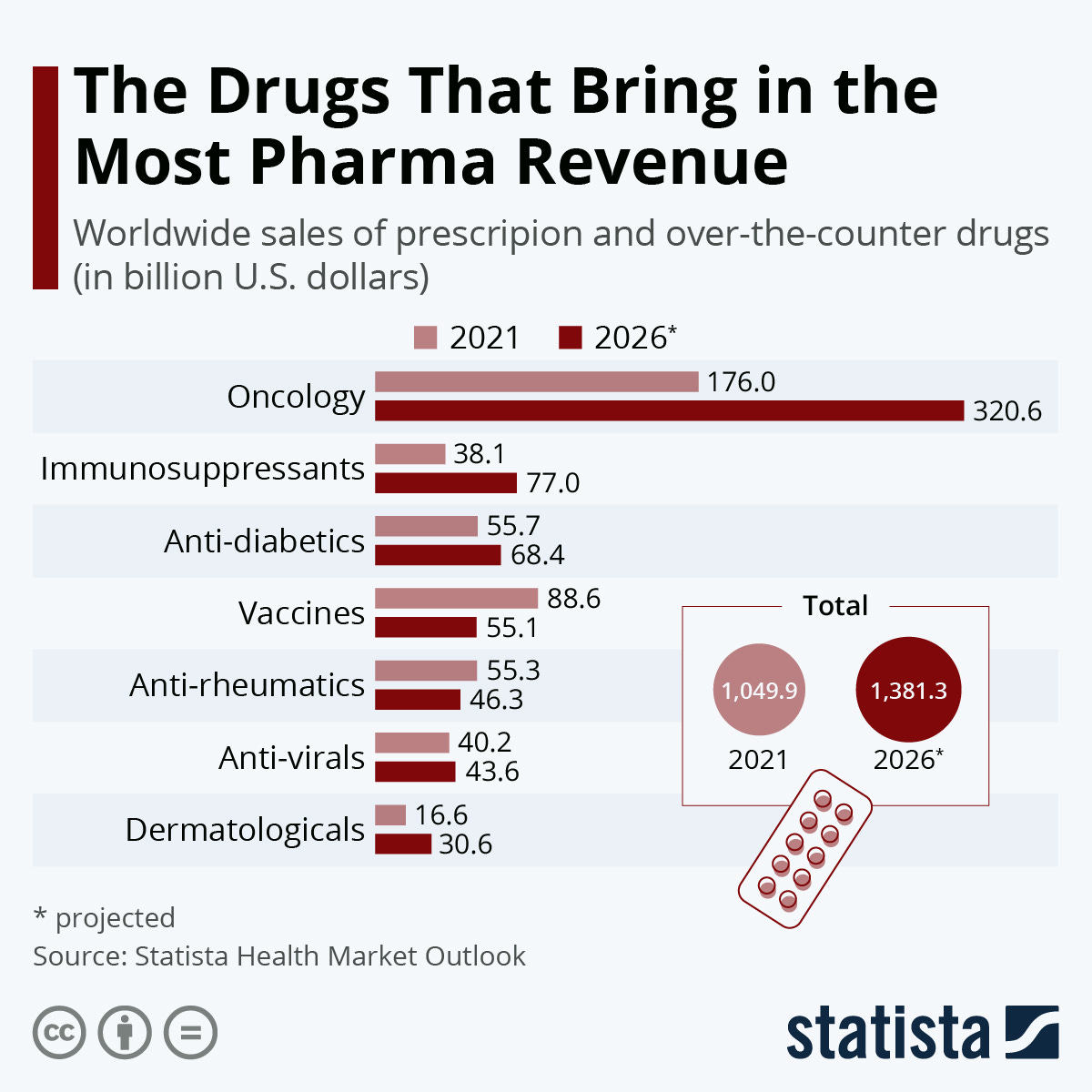
This update incorporates:
- Johnson & Johnson's Q2 2026 results, released July 15, 2026 — the freshest data point in this ranking
- Merck, Bristol Myers Squibb, and AstraZeneca's Q1 2026 filings
- A corrected methodology: Celgene, folded into Bristol Myers Squibb since 2019, is no longer double-counted as a separate company
- Pfizer, whose Seagen-built ADC franchise (Padcev, Adcetris, Tukysa, Tivdak) now generates roughly $16 billion a year in oncology sales, added to the list for the first time
Related: Latest Breakthroughs in Cancer Treatment
In This Article
1. Merck & Co. (MRK)
Keytruda Q1 2026 sales: $8.03 billion (+12%; +8% ex-FX)
Keytruda FY2025 sales: $31.7 billion (+7%)
FY2026 revenue guidance: $65.8B–$67B
Headquarters: Rahway, New Jersey
Merck is still the biggest name in oncology, and it isn't close — Keytruda alone accounts for roughly half of Merck's total pharmaceutical sales. In Q1 2026, the drug grew 12% year over year to $8.03 billion, beating analyst estimates of $7.78 billion, with strength across metastatic settings and continued uptake in earlier-stage cancers such as triple-negative breast and cervical cancer.
Merck is actively working two angles to protect that revenue base. First, it launched a subcutaneous formulation, Keytruda Qlex, which contributed $128 million in its first meaningful quarter — a more convenient injectable format designed to extend the franchise's competitive life even as the intravenous version heads toward its 2028 U.S. patent expiry. Second, Merck has been on an acquisition run to diversify beyond a single asset, agreeing to buy Terns Pharmaceuticals for its hematology pipeline and continuing to explore additional oncology M&A, including a reported look at Inhibrx's cancer assets.
Regulatory momentum has continued into mid-2026: Keytruda and its subcutaneous version won approval in combination with Trodelvy for first-line PD-L1-positive triple-negative breast cancer, and a Keytruda-Padcev combination cleared the EU for cisplatin-ineligible bladder cancer.
2. Johnson & Johnson (JNJ)
Q2 2026 oncology revenue: $7.4 billion (+16.1% operational)
Darzalex Q2 2026: >$4 billion (+17.6%)
Full-year 2026 guidance: raised; company targets >$100 billion in annual revenue for the first time in its 140-year history
J&J delivered the single biggest headline of this year's earnings season. Reported a day before this update, Q2 2026 oncology sales hit $7.4 billion, up 16.1% operationally, with Darzalex — still the company's largest single product — crossing $4 billion in the quarter on 17.6% growth from continued share gains in multiple myeloma. The cell-therapy and bispecific portfolio grew even faster: Carvykti (CAR-T) rose 47.7%, Tecvayli 56.1%, and Talvey 62.6%, while the Rybrevant-Lazcluze lung cancer combination jumped 61.6% on launch momentum and share gains in earlier treatment lines.
Management has been explicit about its ambitions, projecting oncology sales above $50 billion by 2030 and describing a goal of becoming the top oncology company in the world by that date. New data this quarter also showed strong durability for the Talvey-Darzalex combination in earlier-line myeloma, with more than 80% of patients progression-free at two years.
3. Bristol Myers Squibb (BMY)
Opdivo Q1 2026: $2.15 billion (-5%; -8% ex-FX)
Breyanzi Q1 2026: $411 million (+56%)
Q2 2026 earnings date: July 30, 2026 (not yet reported)
BMS is in the middle of a difficult but necessary handoff. Opdivo, its flagship PD-1 inhibitor, declined 5% in Q1 2026 on sales-channel inventory timing, and the company faces full loss of U.S. exclusivity in 2028 as biosimilar developers — including NeuClone, Xbrane Biopharma, and Luye Pharma — advance their own versions. A newer subcutaneous formulation, Opdivo Qvantig, is growing quickly off a small base (more than 200% in Q1 2026) but isn't yet large enough to offset the core decline.
The better news is in BMS's growth portfolio: Breyanzi (CAR-T) rose 56%, Reblozyl 16%, and Opdualag 17% in Q1 2026. The company has also been pruning underperforming pipeline bets — it discontinued the KRAS G12D candidate MRTX1133 acquired via its Mirati buyout after inconsistent pharmacokinetics data, while its G12C inhibitor Krazati remains in the portfolio.
A methodology note on Celgene: Earlier versions of pharma rankings (including this one) sometimes listed Celgene as a standalone top-10 cancer drug company. That's no longer accurate. Celgene was fully absorbed into Bristol Myers Squibb after BMS completed its acquisition in November 2019, and Celgene stock has not traded independently since. Its former flagship, Revlimid (lenalidomide), peaked at $12.8 billion in sales in 2021 and has been in freefall ever since Teva's 2025 generic launch — BMS projects annual declines of $2 billion to $2.5 billion as volume-limited settlements progressively lift. Revlimid and its stablemate Pomalyst are now simply line items inside BMS's legacy portfolio, not a separate company competing for a spot on this list.
4. AstraZeneca (AZN)
Q1 2026 oncology revenue: $6.8 billion (+16% CER)
FY2025 Tagrisso: $7.25 billion | FY2025 Imfinzi: $6.06 billion (+29%)
Q2 2026 earnings date: July 27, 2026 (not yet reported)
AstraZeneca has built what may be the most balanced large-cap oncology pipeline in the industry, with oncology now representing close to 45% of total company revenue. Tagrisso remains the top seller in the segment, and Imfinzi has become a genuine second pillar — Q1 2026 sales for the combined Enhertu franchise (with Daiichi Sankyo) reached $1.42 billion, up from $1.09 billion a year earlier, a 39% increase.
Regulatory catalysts have kept coming: Imfinzi won EU approval in March 2026 as a perioperative immunotherapy for early-stage gastric and gastroesophageal junction cancers, based on Phase 3 MATTERHORN data showing a 22% reduction in risk of death versus chemotherapy alone. AstraZeneca has also backed its long-term oncology ambitions with a $50 billion U.S. manufacturing and R&D investment plan.
5. Roche
Key oncology drivers: Phesgo, Ocrevus, Hemlibra, HER2 franchise
Ticker: ROG / RO.SW (SIX Swiss Exchange)
Roche dominated oncology for years on the strength of Avastin, Herceptin, and Rituxan — all now facing biosimilar erosion as copies from manufacturers including Mylan and Biocon roll out globally. To offset that decline, Roche has leaned on Tecentriq combination regimens in lung and liver cancer and on newer breast-cancer assets like Itovebi, a PI3K inhibitor cleared for certain PIK3CA-mutated cases.
Roche is also investing directly in the next generation of cancer diagnostics and cell therapy: its Q1 2026 update included a definitive agreement to acquire SAGA Diagnostics, whose cancer-therapy-response monitoring platform will extend Roche's oncology diagnostics portfolio, alongside the 2025 acquisition of cell-therapy company Poseida for its allogeneic CAR platform. One high-profile setback: the closely watched Skyscraper-01 trial of TIGIT antibody tiragolumab failed to show an overall survival benefit in combination with Tecentriq, mirroring TIGIT program exits at Merck and BMS.
6. Novartis
Key oncology drivers: Kisqali (breast cancer), Pluvicto (radioligand therapy)
Novartis has carved out a genuinely distinctive niche in radioligand (targeted radiation) therapy. Pluvicto, its PSMA-targeted treatment for metastatic castration-resistant prostate cancer, won an expanded FDA approval for use before chemotherapy following a favorable final overall-survival analysis, and Novartis backed the platform further with a $1 billion acquisition of Mariana Oncology to add actinium-based capabilities alongside Pluvicto's lutetium chemistry.
Kisqali, meanwhile, expanded into adjuvant treatment of certain early-stage HR-positive, HER2-negative breast cancers — a label edge over rival Verzenio (Eli Lilly) because it covers patients without lymph-node involvement. Novartis has projected the broader adjuvant approval could lift Kisqali toward $8 billion in peak sales, up from roughly $3.2 billion generated in 2024 from metastatic use alone.
7. Pfizer (PFE) New to this ranking
Oncology share of revenue: ~29%
Padcev Q1 2026: $591 million (+39% operational)
Pfizer's oncology business has been rebuilt almost entirely around its 2023 acquisition of Seagen, which brought four antibody-drug conjugates — Padcev, Adcetris, Tukysa, and Tivdak — into the portfolio. Padcev has been the standout, growing 39% in Q1 2026 on market-share gains in first-line metastatic urothelial cancer plus early momentum from a newly approved combination with Keytruda in cisplatin-ineligible muscle-invasive bladder cancer. Lorbrena, an ALK-positive lung cancer therapy, grew 38% in Q4 2025 and continues to take share from older options.
Not every Seagen asset is thriving: Adcetris sales declined roughly 13–20% year over year in recent quarters amid competitive pressure. Pfizer has said it is targeting eight or more oncology blockbusters by 2030 and, per its own 2024 disclosures, ranked as the third-largest biopharmaceutical company in U.S. oncology revenue as of the end of that year.
8. Astellas Pharma
Key drugs: Xtandi (prostate cancer), Padcev (co-marketed, urothelial cancer)
Astellas has built a focused, fast-growing oncology franchise concentrated in urology and gastric cancers. Padcev — co-marketed with Pfizer's Seagen unit — more than doubled in the final nine months of 2024, up 110% to roughly ¥117 billion (about $767 million), while Vyloy, a Claudin 18.2-targeted therapy for gastric and gastroesophageal junction cancers, gained momentum as biomarker testing became more widespread. Xtandi remains the anchor of the portfolio in prostate cancer.
9. AbbVie
Key drugs: Imbruvica, Venclexta
Oncology is a secondary — if steady — pillar of AbbVie's business, which is still led by its immunology franchise (Skyrizi, Rinvoq). Imbruvica and Venclexta together account for more than two-thirds of AbbVie's oncology revenue, with Q1 2024 oncology sales of $1.54 billion growing 9% year over year. Imbruvica is shared with Johnson & Johnson under a long-standing partnership dating back to J&J's Pharmacyclics acquisition, and now faces rising competition from AstraZeneca's Calquence in chronic lymphocytic leukemia.
10. Eli Lilly
Focus: In vivo CAR-T therapy
Eli Lilly has the smallest current oncology footprint of the companies on this list, built mainly around Verzenio in breast cancer, but it's making the boldest strategic bet: an up-to-$7 billion deal for Kelonia Therapeutics to build in vivo CAR-T capability — cell therapy manufactured inside the patient's body rather than in a lab, which could eliminate much of the cost and complexity of conventional CAR-T. That would put Lilly in direct competition with J&J, Gilead, and BMS in one of oncology's most closely watched modalities.
Honorable Mentions (High-Growth Specialists)
- Iovance Biotherapeutics — TIL (tumor-infiltrating lymphocyte) therapy leader
- Arcus Biosciences — next-generation checkpoint targets
- ImmunityBio — cytokine-based immunotherapy
- BeiGene — global PD-1 expansion
- Agenus — Fc-enhanced anti-CTLA-4 (botensilimab) plus PD-1 inhibitor (balstilimab) combination immunotherapy
Key 2026 Industry Trends
1. Oncology is still the #1 growth engine. J&J's oncology unit alone generated nearly $7.4 billion in a single quarter — most large pharmaceutical companies now depend on cancer drugs as their primary growth driver.
2. The shift toward cell therapy and CAR-T is accelerating. J&J, BMS, and Lilly are all investing heavily, with "in vivo" CAR-T — simplified delivery without lab-based cell manufacturing — emerging as the next wave.
3. Patent-cliff pressure is building toward 2028–2030. Keytruda's 2028 U.S. exclusivity loss remains the single biggest risk on this list, with Opdivo following the same year — triggering an industry-wide race to launch replacement blockbusters.
4. M&A continues to accelerate. Lilly's up-to-$7 billion Kelonia deal and Merck's continued oncology dealmaking (Terns Pharmaceuticals, prior interest in Inhibrx) show acquirers moving fast to secure next-generation assets ahead of the patent cliff.
Final Ranking (2026 Reality Check)
| Tier | Companies |
|---|---|
| Tier 1 — Dominant Leaders | 1. Merck 2. Johnson & Johnson 3. Bristol Myers Squibb |
| Tier 2 — High-Growth Challengers | 4. AstraZeneca 5. Roche 6. Novartis |
| Tier 3 — Strategic Movers | 7. Pfizer 8. Astellas 9. AbbVie 10. Eli Lilly |
Bottom Line
The oncology market in 2026 is no longer just about who has the single biggest drug — it's about platform innovation (CAR-T, ADCs, radioligands), pipeline depth, and disciplined M&A ahead of the 2028–2030 patent cliff wave. The biggest shift since this ranking was last updated: Johnson & Johnson's Q2 2026 beat moves it into the #2 spot, Pfizer's Seagen-built ADC franchise earns it a first-time place on this list, and Celgene — long gone as an independent company — has been correctly folded into Bristol Myers Squibb.
Ask an AI Assistant About This Data
This article is structured so you can paste it (or its link) into an AI assistant and ask follow-up questions. A few prompts that work well:
Claude: "Using this ranking, compare Merck's Keytruda patent-cliff exposure to AstraZeneca's diversified oncology pipeline — which company carries more concentration risk?"
ChatGPT: "Summarize the Tier 1 companies from this article into a table with 2026 oncology revenue growth rates."
Gemini: "Based on this article, which companies are best positioned for the 2028 patent cliff, and why?"
Perplexity: "Fact-check this article's Q2 2026 Johnson & Johnson oncology figures against the original SEC filing."
Frequently Asked Questions
Which company sells the most cancer drugs by revenue in 2026?
Merck & Co. remains the top-ranked cancer drug company by revenue in 2026, driven almost entirely by Keytruda, which generated $8.03 billion in Q1 2026 alone. Johnson & Johnson has closed the gap fastest, with $7.4 billion in oncology revenue in Q2 2026 after 16.1% year-over-year growth.
What is the best-selling cancer drug in the world?
Keytruda (pembrolizumab), Merck's anti-PD-1 immunotherapy, is the world's best-selling cancer drug, with $31.7 billion in full-year 2025 sales and continued double-digit quarterly growth into 2026.
How will Keytruda's 2028 patent cliff affect the rankings?
Keytruda loses U.S. exclusivity in 2028, threatening roughly half of Merck's pharmaceutical revenue. Merck is defending the franchise with a subcutaneous formulation and new combination approvals, but J&J, AstraZeneca, and BMS's cell-therapy pipelines are widely expected to narrow the gap once biosimilars arrive.
Which pharma company is growing fastest in oncology in 2026?
Johnson & Johnson posted the strongest 2026 oncology growth among large-cap peers, with Q2 sales up 16.1% to $7.4 billion, led by Carvykti (+47.7%), Talvey (+62.6%), and Tecvayli (+56.1%). AstraZeneca is close behind at +16% CER in Q1 2026.
Is Celgene still a separate cancer drug company?
No. Celgene was acquired by Bristol Myers Squibb in 2019 and has operated as a wholly owned BMS subsidiary ever since. Its former flagship, Revlimid, is now reported as part of BMS's legacy portfolio and is declining sharply due to generic competition.
Is this ranking a stock recommendation?
No. This ranking reflects publicly reported oncology drug sales, pipeline activity, and revenue growth. It is not investment advice — consult a licensed financial advisor before making investment decisions.
Sources: Company SEC/6-K filings and Q1–Q2 2026 earnings releases (Merck, Johnson & Johnson, Bristol Myers Squibb, AstraZeneca, Roche, Novartis, Pfizer, Astellas, AbbVie), Reuters, FiercePharma, Pharmaceutical Technology, and company investor relations sources.
Disclaimer: This article is for general informational purposes only and does not constitute financial, investment, or medical advice. Revenue figures and rankings are based on publicly available company disclosures as of July 2026 and are subject to change as later quarters are reported. Readers should verify current figures independently and consult qualified professionals before making business, investment, or healthcare decisions.
Related:
Latest Breakthroughs in Cancer Treatment
Top 10 Selling Cancer Drugs (2026)
Top 10 Pharmaceutical Companies by Revenue
Top 10 Pharma Companies by R&D Spend
Top 10 Emerging Cancer Therapies to Watch


.png)

.png)


.png)

Comments
Post a Comment