Top Cancer Drugs and Cancer Treatment Breakthroughs 2026: Pharma Leaders, Sales and the Future of Oncology
Updated: August 2026
The cancer-drug market is entering a new phase. The era of a few dominant chemotherapy medicines is giving way to a much more sophisticated oncology ecosystem built around immunotherapy, targeted therapy, antibody-drug conjugates (ADCs), cellular therapy, bispecific antibodies, molecular biomarkers, precision medicine and increasingly personalized treatment combinations.
Commercial success increasingly follows scientific progress. Drugs such as Keytruda, Darzalex, Opdivo, Tagrisso, Imfinzi and Enhertu have become major oncology franchises, while newer technologies are attempting to solve problems that conventional therapies cannot: drug resistance, tumor heterogeneity, metastatic disease, immune evasion and the difficulty of treating solid tumors.
This updated article merges two earlier One Day Advisor analyses: the ranking of leading cancer drugs and the review of pharmaceutical cancer-treatment breakthroughs. Rather than simply repeating older 2024 revenue estimates, this version separates verified historical sales from forward-looking industry trends and incorporates important developments through 2026.
Key takeaway: The future of oncology is unlikely to be dominated by one revolutionary drug. It is increasingly being shaped by integrated, biomarker-guided combinations that match the right treatment to the right tumor, at the right stage, while using molecular testing and longitudinal monitoring to adapt when cancer evolves.
Table of Contents
- The Cancer Drug Market in 2026
- The Leading Cancer Drugs
- Keytruda
- Darzalex
- Opdivo
- Tagrisso
- Other Major Oncology Blockbusters
- The Biggest Cancer Treatment Breakthroughs
- Next-Generation Immunotherapy
- Precision Oncology and Biomarkers
- Antibody-Drug Conjugates
- CAR-T, TIL and Cell Therapies
- Bispecific Antibodies
- Personalized Cancer Vaccines
- AI and Cancer Drug Discovery
- Liquid Biopsy and Minimal Residual Disease
- Overcoming Cancer Drug Resistance
- Drug Repurposing: Promise and Evidence Limits
- What Comes Next?
- What the Oncology Market Means for Investors
- Bottom Line
- Sources and Evidence
The Cancer Drug Market in 2026
Oncology remains one of the most important areas of pharmaceutical research and commercial investment. The market is being driven by several overlapping forces:
- Expansion of immunotherapy into earlier stages of disease.
- Rapid growth of antibody-drug conjugates.
- Increasing use of molecular biomarkers to select treatment.
- Growth of cellular therapies and bispecific antibodies.
- Development of treatments for previously difficult-to-drug molecular targets.
- More sophisticated combination therapies.
- Increasing use of artificial intelligence in drug discovery and clinical development.
- Earlier detection and molecular monitoring of cancer.
- Growing attention to mechanisms of acquired treatment resistance.
The commercial landscape also demonstrates an important point: the biggest cancer drugs are not necessarily the newest drugs. Some of the highest-revenue products have accumulated years of evidence, expanded into multiple indications and become embedded in treatment guidelines.
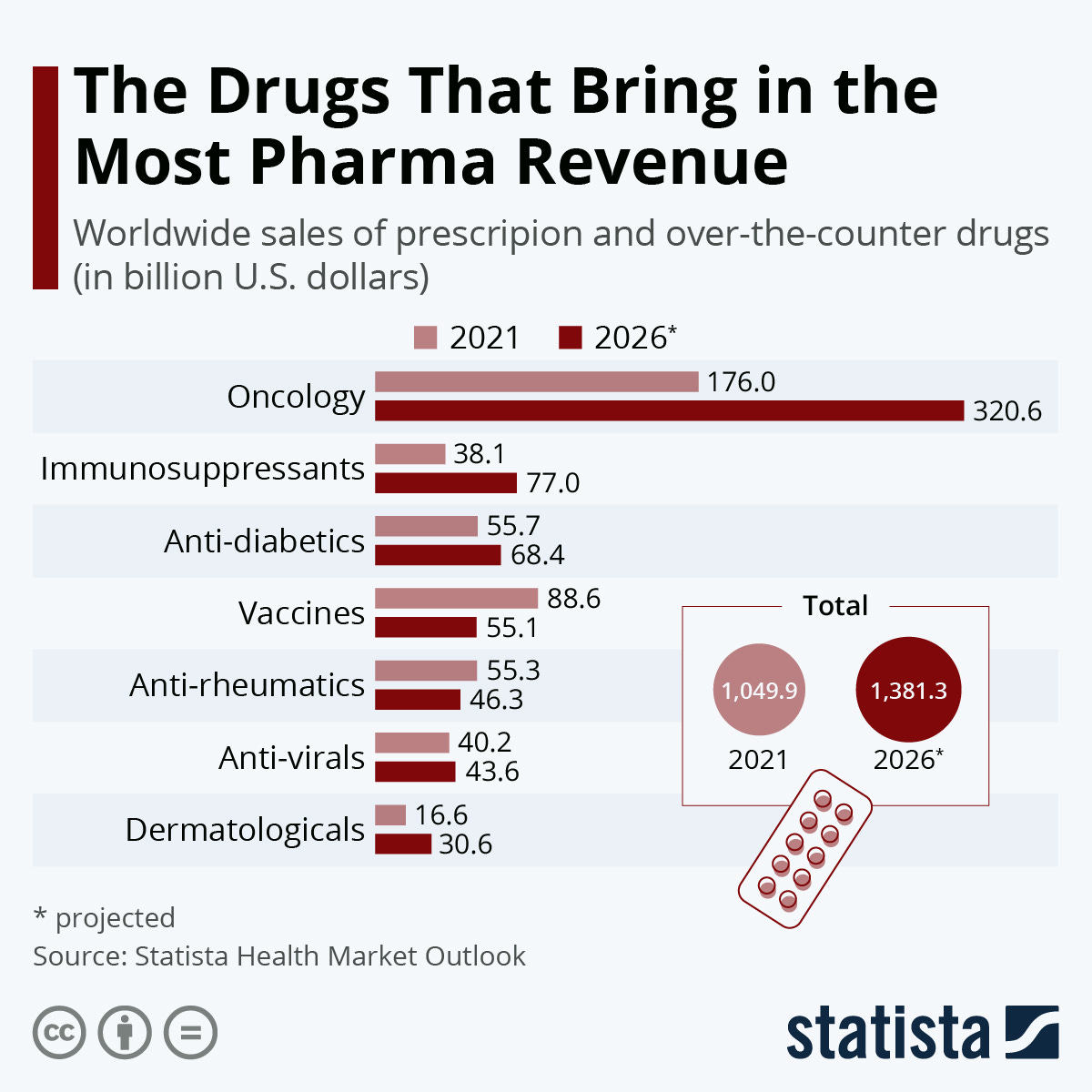
For example, Merck reported $31.68 billion in 2025 sales for Keytruda and Keytruda Qlex, up 7% from 2024. Johnson & Johnson reported $25.38 billion in worldwide oncology sales in 2025, driven in large part by Darzalex, Carvykti and other oncology products.
These figures illustrate why oncology is strategically important to the world's largest pharmaceutical companies.
The Leading Cancer Drugs
Ranking cancer medicines is more complicated than it first appears. Companies report revenues differently, some products are co-commercialized, and some franchises include multiple formulations or indications.
For that reason, the following list should be viewed as a market and oncology-franchise overview rather than a definitive real-time global ranking. Where full-year 2025 company-reported figures are available, they are prioritized. For other products, the latest comparable reported sales are identified rather than presenting estimates as fact.
1. Keytruda (Pembrolizumab)
Company: Merck & Co.
Class: PD-1 immune checkpoint inhibitor
2025 sales: Approximately $31.7 billion for Keytruda/Keytruda Qlex.
Keytruda remains the defining commercial success story of modern oncology. It works by blocking the PD-1 immune checkpoint, helping T cells recognize and attack cancer cells.
Its approved uses span numerous cancers, including melanoma, non-small cell lung cancer, head and neck cancer, renal cell carcinoma, bladder cancer, gastric cancer, cervical cancer, endometrial cancer, triple-negative breast cancer and selected biomarker-defined tumors.
Its commercial strength is not based on a single indication. Instead, Merck has continually expanded the drug into new cancer types, disease stages and treatment combinations.
That strategy has transformed Keytruda from a metastatic-disease treatment into a platform used across multiple points in the cancer-treatment pathway, including selected perioperative settings.
Merck reported that Keytruda and Keytruda Qlex generated $31.68 billion in 2025 sales, compared with $29.48 billion in 2024.
Why it matters: Keytruda demonstrates how biomarker selection, combination therapy and expansion into earlier-stage disease can turn one molecular mechanism into a multi-billion-dollar oncology franchise.
2. Darzalex (Daratumumab)
Company: Johnson & Johnson
Class: CD38-targeted monoclonal antibody
Main disease: Multiple myeloma and related plasma-cell disorders
Darzalex has become one of the most important medicines in multiple myeloma. It targets CD38, a protein expressed on myeloma cells, and promotes immune-mediated destruction of malignant plasma cells.
Johnson & Johnson reported $14.35 billion in 2025 Darzalex sales, combining worldwide sales across the franchise. That represents substantial growth from 2024.
Its importance also reflects a broader transformation in myeloma treatment. Modern multiple myeloma care increasingly combines monoclonal antibodies, proteasome inhibitors, immunomodulatory agents, steroids, bispecific antibodies and cellular therapies.
In November 2025, the FDA approved Darzalex Faspro as a treatment for adults with high-risk smoldering multiple myeloma, representing an important shift toward earlier intervention before progression to active disease.
3. Opdivo (Nivolumab)
Company: Bristol Myers Squibb and Ono Pharmaceutical
Class: PD-1 immune checkpoint inhibitor
Opdivo is one of Keytruda's major competitors and another foundational checkpoint inhibitor.
Its applications include melanoma, lung cancer, renal cell carcinoma, head and neck cancer, urothelial cancer, hepatocellular carcinoma, esophageal cancer and biomarker-selected colorectal cancer, among others.
Like Keytruda, Opdivo has increasingly been used in combination regimens. One of the most important strategies is combining PD-1 inhibition with CTLA-4 blockade using ipilimumab.
The FDA also expanded the use of nivolumab plus ipilimumab in 2025 for selected patients with unresectable or metastatic hepatocellular carcinoma and MSI-H/dMMR colorectal cancer.
4. Tagrisso (Osimertinib)
Company: AstraZeneca
Class: EGFR tyrosine kinase inhibitor
Main disease: EGFR-mutated non-small cell lung cancer
Tagrisso illustrates the power of precision oncology.
Instead of treating lung cancer purely according to its anatomical location, oncologists can identify specific molecular alterations such as EGFR mutations and select a targeted therapy designed around that biology.
AstraZeneca reported approximately $7.0 billion in 2025 Tagrisso sales, making it one of the company's most important oncology products.
Tagrisso has become a cornerstone of treatment for several EGFR-mutated NSCLC settings, including metastatic disease and selected earlier-stage disease.
In August 2026, AstraZeneca also reported positive results for a Tagrisso-plus-savolitinib combination in EGFR-mutated NSCLC, illustrating the continuing evolution of targeted combinations for resistant disease.
Other Major Oncology Blockbusters
The oncology market is far larger than four drugs. Several additional medicines have become major commercial franchises.
- Imfinzi (durvalumab) — AstraZeneca's PD-L1 inhibitor used across several cancers, particularly lung cancer.
- Enhertu (trastuzumab deruxtecan) — a leading antibody-drug conjugate targeting HER2 and increasingly important across multiple tumor types.
- Verzenio (abemaciclib) — a CDK4/6 inhibitor used extensively in hormone-receptor-positive breast cancer.
- Ibrance (palbociclib) — another major CDK4/6 inhibitor for HR-positive/HER2-negative breast cancer.
- Xtandi (enzalutamide) — an androgen-receptor pathway inhibitor used in prostate cancer.
- Lynparza (olaparib) — a PARP inhibitor used in biomarker-selected cancers, including BRCA-associated disease.
- Calquence (acalabrutinib) — a BTK inhibitor used in B-cell malignancies.
- Erleada (apalutamide) — an androgen-receptor inhibitor for prostate cancer.
- Jakafi (ruxolitinib) — a JAK1/JAK2 inhibitor used in myelofibrosis and other hematologic conditions.
- Imbruvica (ibrutinib) — an established BTK inhibitor for several B-cell malignancies.
- Kisqali (ribociclib) — a CDK4/6 inhibitor whose use in breast cancer has expanded substantially.
- Pomalyst/Imnovid (pomalidomide) — an immunomodulatory medicine used in multiple myeloma.
The composition of this list is changing rapidly. Older blockbusters face patent expiration and competition, while newer platforms such as ADCs, bispecific antibodies and cellular therapies are generating new commercial opportunities.
The Biggest Cancer Treatment Breakthroughs
Drug sales tell only part of the story. The more important question is: where is oncology actually going?
The major technological trends can be grouped into several interconnected areas.
1. Next-Generation Immunotherapy
Checkpoint inhibitors changed oncology by demonstrating that stimulating the immune system can produce durable responses in some advanced cancers.
The next generation is moving beyond simple PD-1 or PD-L1 blockade.
- PD-1 and PD-L1 inhibitors.
- CTLA-4 inhibitors.
- LAG-3 and other emerging checkpoints.
- Bispecific T-cell engagers.
- TIL therapy.
- TCR-engineered therapies.
- CAR-T cell therapy.
- Oncolytic viruses.
- Personalized cancer vaccines.
The objective is increasingly to activate, redirect, expand or genetically engineer the patient's immune system rather than simply administer cytotoxic chemotherapy.
2. Precision Oncology and Biomarkers
Modern cancer treatment increasingly begins with a molecular question:
What is driving this particular tumor?
Important biomarkers can include:
- EGFR
- ALK
- ROS1
- KRAS
- BRAF
- HER2
- BRCA1/2
- PIK3CA
- ESR1
- RET
- NTRK
- MET
- MSI-H/dMMR
- TMB
- PD-L1
This is one reason comprehensive genomic profiling has become increasingly important in advanced cancer.
Instead of asking only whether someone has lung, breast or colorectal cancer, precision oncology asks which molecular subtype the tumor represents.
That distinction can completely change treatment selection.
3. Antibody-Drug Conjugates: The New Precision Chemotherapy
Antibody-drug conjugates combine two concepts:
- A targeted antibody that recognizes a molecular feature on cancer cells.
- A highly potent cytotoxic payload attached to the antibody.
The concept is sometimes described as a molecular delivery system for chemotherapy.
Enhertu is one of the most important examples. Its success has helped establish ADCs as one of the most commercially and scientifically important areas in oncology.
Other ADC platforms are targeting HER2, TROP2, BCMA and additional cancer-associated antigens.
The major challenge is that ADCs are not automatically selective enough to eliminate toxicity. Their therapeutic window, target expression, payload characteristics and resistance mechanisms remain important considerations.
4. CAR-T, TIL and Cell Therapies
Cell therapy represents perhaps the most radical change in cancer treatment.
Rather than giving the patient a conventional drug, physicians can modify or expand immune cells and return them to the patient.
CAR-T therapy has demonstrated remarkable activity in several blood cancers, particularly certain leukemias, lymphomas and multiple myeloma.
But solid tumors are much harder.
Solid tumors may contain heterogeneous cancer cells, suppressive immune environments, physical barriers and normal tissues expressing similar antigens.
Researchers are therefore exploring:
- Dual-target CAR-T cells.
- Logic-gated CAR-T systems.
- Armored CAR-T cells.
- Safety switches.
- Allogeneic cell therapies.
- In-vivo CAR-T approaches.
- TIL therapy.
- TCR-engineered T cells.
The long-term objective is to make cell therapy more scalable, safer and effective against solid tumors.
5. Bispecific Antibodies
Bispecific antibodies are designed to bind two different targets simultaneously.
One common strategy is to bind a cancer-associated antigen with one arm and a T-cell target such as CD3 with the other.
This effectively creates a molecular bridge between the cancer cell and the immune system.
Bispecific antibodies are becoming particularly important in hematologic cancers such as multiple myeloma and B-cell malignancies.
They could eventually expand into solid tumors as researchers improve target selection, tumor penetration and safety.
6. Personalized Cancer Vaccines
One of the most closely watched developments in oncology is the personalized cancer vaccine.
Unlike preventive vaccines against infectious diseases, these vaccines are designed around the molecular characteristics of an individual's tumor.
The basic concept is:
- Sequence the patient's tumor.
- Identify tumor-specific mutations or neoantigens.
- Design a personalized vaccine.
- Train the immune system to recognize those targets.
- Combine the vaccine with other immune therapies when appropriate.
In August 2026, Moderna and Merck reported positive late-stage results for their personalized mRNA cancer vaccine candidate intismeran combined with Keytruda in high-risk melanoma after surgery. The companies reported reductions in recurrence and metastasis, although detailed trial data and longer-term outcomes remain important for judging the full clinical significance.
The development is potentially important because it suggests that personalized vaccination could eventually become part of post-surgical recurrence prevention rather than simply treatment of established metastatic disease.
7. AI and Cancer Drug Discovery
Artificial intelligence is becoming an increasingly important tool throughout the oncology development process.
Potential applications include:
- Analyzing tumor genomic data.
- Predicting drug-target interactions.
- Identifying drug combinations.
- Designing new molecules.
- Predicting treatment response.
- Analyzing pathology images.
- Improving radiotherapy planning.
- Identifying patients for clinical trials.
- Predicting resistance mechanisms.
However, AI should not be confused with clinical validation. A machine-learning model can generate a promising hypothesis, but that hypothesis still requires laboratory testing and appropriately designed clinical trials.
The most important opportunity may therefore be AI-assisted precision oncology, where computational models integrate genomics, pathology, imaging, treatment history and longitudinal clinical data.
8. Liquid Biopsy and Minimal Residual Disease
Traditional cancer monitoring often depends on imaging or tissue biopsy. Liquid biopsy offers another possibility: detecting tumor-derived material in blood.
Circulating tumor DNA (ctDNA) is being studied for:
- Early cancer detection.
- Minimal residual disease detection.
- Recurrence monitoring.
- Treatment-response assessment.
- Resistance detection.
- Selection of targeted therapy.
One of the most interesting applications is minimal residual disease (MRD).
A patient may have no visible tumor on imaging but still harbor microscopic disease capable of causing relapse. Molecular monitoring could eventually help identify which patients need additional treatment and which patients may safely avoid it.
This could make cancer treatment more adaptive and potentially reduce unnecessary toxicity.
9. Overcoming Cancer Drug Resistance
Drug resistance remains one of oncology's biggest unsolved problems.
A treatment may initially shrink a tumor and then stop working because cancer cells evolve.
Resistance can arise through:
- New mutations.
- Activation of alternative signaling pathways.
- Drug efflux mechanisms.
- Phenotypic changes.
- Tumor heterogeneity.
- Immune suppression.
- Changes in the tumor microenvironment.
This is why the future of oncology is increasingly focused on sequential and combination treatment strategies.
For example, a patient with EGFR-mutated lung cancer may initially respond to an EGFR inhibitor but later develop resistance. The next treatment decision may depend on a new molecular alteration detected through tissue or liquid biopsy.
The cancer is therefore treated as a moving biological system rather than a static disease.
10. Drug Repurposing: Promise and Evidence Limits
Drug repurposing has attracted considerable interest because existing medicines can sometimes affect biological pathways involved in cancer.
Examples investigated in oncology research include metformin and various other established medicines. Some antiparasitic drugs, including ivermectin, mebendazole and fenbendazole, have also generated laboratory studies, case reports and hypotheses about potential anticancer mechanisms.
However, this area requires particularly careful evidence grading.
Laboratory activity is not proof of clinical efficacy.
A drug may kill cancer cells in a laboratory concentration that cannot safely be achieved in humans. Case reports can generate hypotheses but cannot establish effectiveness because of selection bias, spontaneous variation, concurrent treatments and other confounding factors.
Therefore, repurposed medicines should not be presented as established cancer treatments unless supported by appropriate clinical evidence and regulatory approval for the specific cancer indication.
This distinction is essential for responsible cancer communication.
What Comes Next in Cancer Treatment?
The next decade of oncology is likely to be defined by convergence rather than by one single technology.
The most important model may look something like this:
Early Detection → Molecular Profiling → Risk Stratification → Precision Treatment → Combination Therapy → Molecular Monitoring → Resistance Detection → Treatment Adaptation
In this model, cancer treatment becomes an iterative process.
A patient's tumor is characterized. Treatment is selected. The response is monitored. Molecular changes are detected. Therapy is adapted.
This is fundamentally different from the older model of giving a standard chemotherapy regimen and waiting for the next scan.
From "One Drug" to Integrated Multi-Modal Oncology
The most important conceptual change may be the move from single-drug oncology toward integrated multi-modal treatment.
A future treatment plan may combine several components:
- Surgery.
- Radiotherapy.
- Targeted therapy.
- Immunotherapy.
- Antibody-drug conjugates.
- Cell therapy.
- Hormonal therapy.
- Metabolic interventions.
- Clinical-trial therapies.
- Supportive and symptom-management care.
The objective is not to use everything simultaneously. It is to identify the right combination for the right biological context.
This distinction is important because more treatment is not automatically better treatment. Combination therapy can increase efficacy, but it can also increase toxicity, drug interactions, cost and treatment burden.
What the Oncology Market Means for Investors
For investors, the oncology market presents both enormous opportunity and substantial risk.
Established blockbusters can generate extraordinary cash flow, but they eventually face:
- Patent expiration.
- Biosimilar competition.
- Generic competition.
- Clinical trial failures.
- Pricing pressure.
- Changing treatment standards.
- Safety concerns.
- Competition from newer mechanisms.
Merck's Keytruda illustrates the issue particularly well. The product generated approximately $31.7 billion in 2025, but Merck is simultaneously preparing for the eventual loss of exclusivity and building new oncology and non-oncology growth drivers.
Johnson & Johnson provides another example of the industry's strategy. Its oncology portfolio generated approximately $25.4 billion in 2025, with growth from Darzalex, Carvykti and newer products helping expand the franchise.
AstraZeneca is similarly building a diversified oncology portfolio around Tagrisso, Imfinzi, Enhertu, Calquence and other medicines.
For investors, therefore, the more important question is often not simply:
"Which company sells the biggest cancer drug?"
but:
"Which company has the strongest portfolio of mechanisms, biomarkers, combinations and next-generation technologies after its current blockbusters mature?"
Why 2026 Is an Important Transition Year
Several trends are converging:
- Checkpoint inhibitors are moving into earlier disease settings.
- ADCs are expanding across tumor types.
- Bispecific antibodies are becoming increasingly important.
- Cell therapies are moving beyond their original indications.
- Precision oncology is becoming more sophisticated.
- Personalized cancer vaccines are producing increasingly important clinical data.
- AI is becoming integrated into drug discovery and clinical development.
- Liquid biopsy and ctDNA monitoring are moving toward broader clinical utility.
- Pharmaceutical companies are increasingly relying on combinations and lifecycle management to extend major oncology franchises.
At the same time, the field remains highly uncertain. Many promising cancer drugs fail during development. A compelling biological mechanism does not guarantee a meaningful survival benefit in humans.
Bottom Line
The world's leading cancer drugs provide a useful window into the transformation of oncology.
Keytruda demonstrated the commercial and clinical power of immune checkpoint inhibition. Darzalex illustrates the transformation of multiple myeloma treatment. Tagrisso demonstrates how molecularly targeted therapy can reshape treatment for genetically defined cancers. Enhertu highlights the rapid rise of antibody-drug conjugates.
But the next generation of oncology may be even more important.
The future is increasingly being built around precision medicine, biomarker-driven treatment, combination therapy, adaptive monitoring, cellular therapies, bispecific antibodies, personalized vaccines, liquid biopsy and AI-assisted drug discovery.
The ultimate goal is not simply to develop more cancer drugs. It is to develop a system capable of determining which treatment will work for which patient, when it should be given, how it should be combined, and when it should be changed.
The big picture: Oncology is moving from a "one-size-fits-most" model toward an adaptive, data-driven and increasingly personalized system of cancer care. The winners of the next decade may be the therapies and platforms that can integrate multiple biological signals rather than simply attack cancer through one mechanism.
Important 2025–2026 FDA Developments
The FDA oncology approval landscape reinforces how rapidly the field is changing. Recent approvals and regulatory decisions have included new or expanded therapies involving CAR-T, bispecific antibodies, targeted therapies, antibody-drug conjugates, immune checkpoint inhibitors, menin inhibitors and biomarker-defined treatments.
Examples include:
- Tarlatamab received traditional FDA approval in November 2025 for extensive-stage small-cell lung cancer after platinum-based therapy.
- Ziftomenib was approved in November 2025 for relapsed or refractory AML with a susceptible NPM1 mutation.
- Enhertu plus pertuzumab received FDA approval in December 2025 for first-line HER2-positive metastatic breast cancer.
- Lisocabtagene maraleucel was approved for relapsed or refractory marginal zone lymphoma.
- Vusolimogene oderparepvec received accelerated approval in August 2026 in combination with nivolumab for selected advanced melanoma.
- Iberdomide combinations received accelerated approval in August 2026 for selected multiple myeloma patients.
These developments illustrate the broader direction of oncology: increasingly precise patient selection, immune engineering, targeted therapies and combination strategies.
Frequently Asked Questions
What is the world's best-selling cancer drug?
Keytruda (pembrolizumab) remains the leading cancer drug by global sales. Merck reported approximately $31.68 billion in 2025 sales for Keytruda and Keytruda Qlex.
What is the most important class of cancer drugs?
There is no single best class for every cancer. Immunotherapy, targeted therapy, ADCs, hormonal therapy, cellular therapy and conventional chemotherapy all remain important depending on cancer type, stage, biomarkers and patient factors.
Are cancer drugs becoming more personalized?
Yes. Genomic profiling, biomarker testing, pathology, liquid biopsy and other molecular technologies increasingly allow treatment to be selected according to tumor biology rather than anatomy alone.
Are antibody-drug conjugates replacing chemotherapy?
Not broadly. ADCs can be viewed as a more targeted way of delivering highly potent cytotoxic payloads, but they remain associated with significant adverse effects and are not appropriate for every patient or tumor.
Will personalized cancer vaccines replace immunotherapy?
That is not established. Personalized vaccines are being investigated as a potential addition to existing immunotherapy and other treatments. The encouraging 2026 melanoma results from the Moderna-Merck program are important, but longer-term and broader clinical evidence remains necessary.
Is AI going to cure cancer?
AI is unlikely to be a standalone cure. Its more realistic role is to accelerate drug discovery, improve diagnosis and treatment selection, analyze complex biological data and help researchers identify new therapeutic combinations.
Are repurposed drugs proven cancer treatments?
Some repurposed drugs already have established cancer indications. Other medicines are being investigated for potential anticancer effects. Preclinical research and case reports are not sufficient to establish clinical efficacy, so experimental repurposing should not be presented as equivalent to approved cancer treatment.
Sources and Evidence
This updated article prioritizes company annual reports, FDA oncology approval records and major pharmaceutical-company financial disclosures. Key sources include:
- U.S. Food and Drug Administration: Oncology and Hematologic Malignancies Approval Notifications.
- Merck & Co.: Full-year 2025 financial results and Keytruda sales.
- Johnson & Johnson: Full-year 2025 results and oncology portfolio sales.
- AstraZeneca: 2025 Annual Report and oncology product performance.
- Roche: Annual and interim financial reports covering oncology products.
- Bristol Myers Squibb: Annual reporting and Opdivo performance.
- Peer-reviewed oncology literature: clinical trials and systematic reviews covering immunotherapy, precision oncology, ADCs, cell therapy, biomarkers and emerging cancer technologies.
Editorial note: Drug revenue is a commercial measure, not a measure of clinical effectiveness. A high-selling medicine may be widely used because it treats a large patient population, has multiple indications or has strong commercial positioning. Conversely, an important treatment may have relatively low sales because it targets a rare cancer.
Medical and Investment Disclaimer
This article is for educational and informational purposes only. It does not constitute medical advice, diagnosis, treatment advice or a recommendation to use any particular cancer drug.
Cancer treatment decisions depend on cancer type, stage, molecular profile, previous treatment, overall health, treatment goals and patient preferences. FDA approvals and treatment guidelines can change, and a medicine approved for one cancer should not be assumed to be effective for another cancer.
Revenue figures are also not investment recommendations. Pharmaceutical companies face clinical, regulatory, patent, pricing and competitive risks. Investors should consult primary company filings and qualified financial professionals before making investment decisions.
Last reviewed: August 2026


.png)


.png)

.png)

Comments
Post a Comment